Forged by Bart D. Ehrman
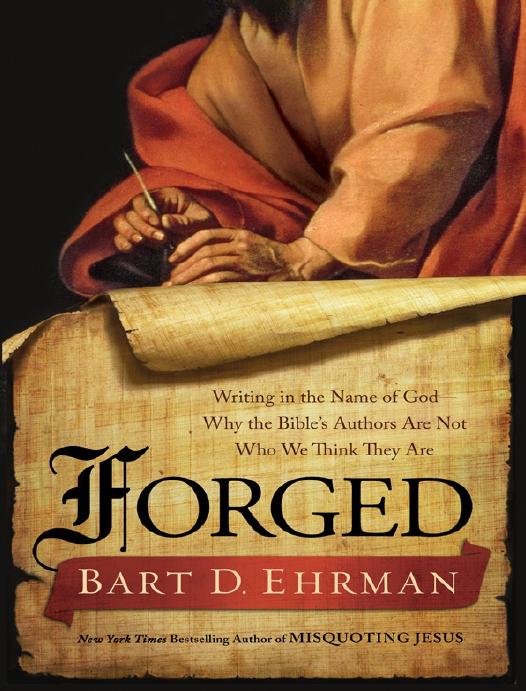
Author:Bart D. Ehrman
Language: eng
Format: mobi, epub, pdf
Publisher: HarperCollins
Published: 2011-04-26T21:00:00+00:00
According to the narrative of the letter, after Pilate did “a terrible thing” in having Jesus crucified, he hears that he was raised from the dead. Procla and Longinus go to find Jesus in Galilee. There he speaks with them, and they become convinced of his resurrection. When Pilate learns that Jesus has returned to life, he falls to the ground in deep grief. But then Jesus himself appears to him, raises him from the ground, and declares to him, “All generations and nations will bless you.” Here Pilate is not only repentant; he is a Christian convert who will be considered fortunate by later adherents of the faith.
The Letter of Pilate to Claudius
We have another letter allegedly from Pilate to a Roman official, but this time it is supposedly directed to the Roman emperor Claudius, written to explain Pilate’s role in the death of Jesus, the Letter of Pilate to Claudius.5 It may seem strange for Pilate to be writing to Claudius, in particular, given the fact that it was Tiberius, not Claudius, who was emperor when Pilate condemned Jesus to death (Claudius became emperor a decade later). Possibly this letter was forged so long after the fact that the forger did not have the facts of imperial history from two hundred years earlier straight (do you know who was president of the United States in 1811?).
One of the places the letter is preserved for us is in a fabricated account of the missionary activities of the apostles called the Acts of Peter and Paul. In this account we are told that years after Jesus’s death, the apostle Peter and the archheretic Simon the Magician, whom we met earlier, appear before the emperor Nero, evidently in the early 60s CE. When the emperor hears about Christ, he asks Peter how he can learn more about him. Peter suggests that he retrieve the letter that Pilate had sent to his predecessor, the emperor Claudius, and to have it read aloud. He does so, and the letter then is quoted in full.
The idea that Pilate may have written a letter to the emperor to explain the death of Jesus was widespread in early Christianity. We have references to some such letter as early as the third century in the writings of the church father Tertullian and in the fourth century in the Church History of Eusebius.6 The letter I am discussing here is probably not the one referred to by these two authors. Possibly this one was composed by a forger who thought that some such letter must once have existed. The themes of the short letter are very similar to ones we have already explored. It is the wicked Jews who are responsible for Jesus’s death, and they will be punished by God for it. As “Pilate” states in the letter:
The Jews, out of envy, have brought vengeance both on themselves and on those who come after them by their terrible acts of judgment. They have been oblivious to the
Download
This site does not store any files on its server. We only index and link to content provided by other sites. Please contact the content providers to delete copyright contents if any and email us, we'll remove relevant links or contents immediately.
The Five People You Meet in Heaven by Mitch Albom(3577)
The Secret Power of Speaking God's Word by Joyce Meyer(3242)
Real Sex by Lauren F. Winner(3027)
Name Book, The: Over 10,000 Names--Their Meanings, Origins, and Spiritual Significance by Astoria Dorothy(2990)
The Holy Spirit by Billy Graham(2961)
0041152001443424520 .pdf by Unknown(2850)
How The Mind Works by Steven Pinker(2822)
ESV Study Bible by Crossway(2782)
Ancient Worlds by Michael Scott(2693)
Churchill by Paul Johnson(2590)
The Meaning of the Library by unknow(2579)
The ESV Study Bible by Crossway Bibles(2554)
The Gnostic Gospels by Pagels Elaine(2537)
MOSES THE EGYPTIAN by Jan Assmann(2419)
Jesus by Paul Johnson(2366)
City of Stairs by Robert Jackson Bennett(2360)
The Complete Dead Sea Scrolls in English (7th Edition) (Penguin Classics) by Geza Vermes(2293)
The Nativity by Geza Vermes(2234)
Ancient Near Eastern Thought and the Old Testament by John H. Walton(2227)
